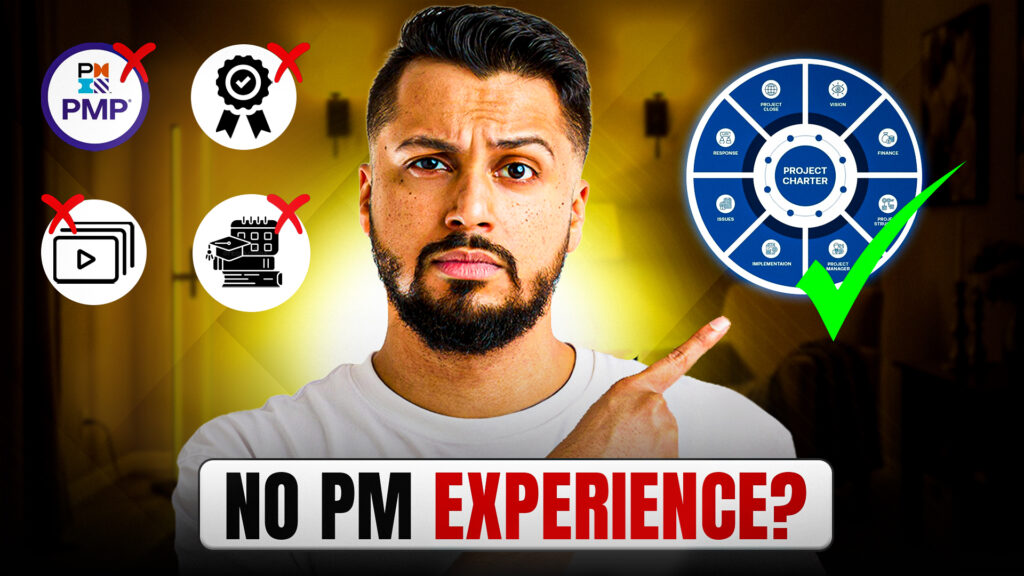
A few years ago, I got tired of telling people the same thing over and over: you do not have a knowledge problem, you have an experience problem. And no certification, no course, and no YouTube video is going to fix that.
So I built something else. A real Live Project Management Office for people who have never held a PM title, do not have a PM job, and cannot seem to break into the field no matter what they try. Here is how it works, and why it produces results that a PMP prep course is never going to match.
The Real Problem: You Have an Experience Deficit, Not an Information One
Almost every product in the PM space teaches you about project management. Books. Courses. Certifications. Videos. Boot camps. They all sell information.
But the people buying them do not have an information deficit. They have an experience deficit. You can read every book ever written on project management and still walk into a hiring manager’s office unable to describe a real project you have run. You can pass the PMP and still freeze when an executive asks you a hard question in your first interview.
Real project management is something you have to do, under pressure, with stakeholders and real consequences. Until you have done it, you cannot talk about it. And until you can talk about it, hiring managers do not believe you can do it. That is the loop the existing industry is structurally unable to break, because the moment they break it, they stop selling courses.
What I Built Instead (Not a Course)
The Live PMO is the opposite of a course. There is no curriculum to read through, no certificate at the end, and no exam. It is a structured project management training environment where every member runs a full project simulation from kickoff to closeout, defends their decisions live in front of the group, and walks out with a portfolio of real deliverables they built themselves.
It is modeled on how an actual corporate PMO operates. Members join, go through training, then pick a project simulation and manage it through four formal phase gates over 27 days: initiation, planning, execution, and closure.
How the Live PMO Works
1. You Do Not Walk In Cold
When you join, the first thing you do is go through a structured training program. It covers the fundamentals: how a real PMO operates, what each phase gate requires, how deliverables get built, and how the live presentations work. It is the minimum context you need to walk in informed and confident, the way a new hire would be prepared in a real organization. Training also includes templates for every phase-gate deliverable: charters, plans, RAID logs, steering committee updates, and closeout reports.
2. A 27-Day Project Simulation
Once you are ready, you pick a simulation. Each one is a full project with a defined scope, a sponsor, stakeholders, a budget, and the kind of complications that show up in real PM work. You manage it for 27 days. Stakeholders come to you with requests. Vendors miss deadlines. Sponsors change priorities. Risks surface. Scope creeps. You decide what to do, in writing, and the simulation responds based on the choices you made. This is not a multiple-choice exercise or a one-day case study. It is a 27-day arc where your week-one decisions show up in week three.
3. Phase Gates Every Six Days
Every six days or so, you hit a formal phase gate. There are four in total. Initiation, around day six: you prepare and defend a project charter. Planning, around day twelve: you deliver a real schedule, RAID log, resource plan, and budget structure. Execution, around day eighteen to twenty: you produce a steering committee update that reports progress, surfaces issues, and proposes decisions. Closure, around day 27: you write the closeout report with final budget, timeline, and lessons learned. Each gate is a pressure test. If you cannot make the case to advance, you do not advance.
4. Live Presentations and Defending Your Work
You do not just submit your deliverables in writing. You schedule a live presentation in the PMO and defend them in front of other members and a senior PM. That is exactly what every new PM has to do in a real corporate environment: walk into a room, present a status, take questions, and hold your position when someone pushes back. That skill is the part nobody can teach you in a video. If your charter is weak, someone tells you. If your plan has gaps, someone finds them. You take the feedback, fix the work, and move forward.
Want a structured path into project management? Start here.
A Real Example: From 30 Rejections to Hired
One member joined last year after four years as an operations analyst. She had taken the PMP twice and applied to roughly thirty PM roles with no callbacks. She was about to give up on the career change entirely.
She went through training and picked a software rollout simulation with a tight timeline and an executive sponsor she had to manage carefully. By day six she had written and defended her first charter. She got pushed on her stakeholder analysis, fixed it, and moved forward. By day twelve she was presenting a project plan. By day twenty she was running a steering committee update on a project that had gone sideways and explaining how she planned to recover. By day 27 she had closed it out with four real deliverables and four live presentations behind her.
She started applying again. In her first interview, the hiring manager asked her to walk through a recent project. She did: scope, stakeholders, the recovery plan she built when execution went sideways, and what she would do differently. When he asked which company it was at, she told him the truth. It was a structured PMO simulation, not a paid job. He hired her anyway, because the work was real, the decisions were real, and he could feel the difference between someone reading from theory and someone describing something they had actually done.
Who the Live PMO Is For
If you have been stuck for years, if courses and certifications have not worked, and if every attempt to break into PM has hit the same wall, this is the thing I would point you to. It is not for everyone. It is a real time commitment. You actually have to run a simulation, build the deliverables, and stand up in front of the group to defend your work. It is not a buy-it-and-watch-it product.
But if you are willing to do that, and you want 27 days of structured PM experience that actually counts when you walk into an interview, the Live PMO is where that experience happens on purpose.
Related reading
- What Hiring Managers See When You ‘Know’ Project Management But Have No Experience
- Why Most People Stay Stuck Trying to Break Into Project Management
- Project Coordinator vs Project Manager: What Nobody Tells You
- Project Management Experience Examples (What to Put on Your Resume)
Ready to Close the Experience Gap?
Join The Eddie System and gain real IT PM experience inside a live PMO environment.