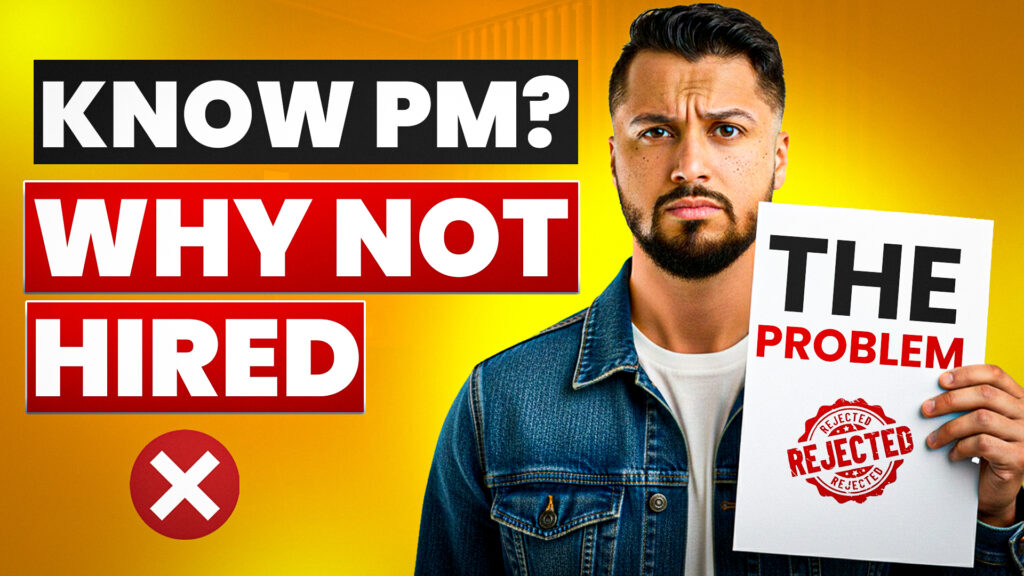
There are two types of PM candidates: the ones who know the material, and the ones who actually get hired. If you’ve been studying project management — reading the books, taking the courses, maybe even earning a certification — and still hearing nothing back from applications, this is why.
The gap between knowing PM and being hireable as a PM is real. And most people don’t see it until they’ve already applied to twenty jobs with no response.
Hiring Is Not a Knowledge Test
Here’s the pattern. Someone decides to move into project management. They study, they put in the time. They learn about project charters, stakeholder registers, risk matrices, Agile ceremonies. They learn the vocabulary. They understand the frameworks. Then they start applying — and every job posting says the same thing: 1-2 years of experience required.
So they think: if I keep studying or get another certificate, I’ll convince them I know how to do the job. But that’s not the actual problem. They’ve been treating this as a knowledge gap. And hiring is not a knowledge test.
What Hiring Managers Are Actually Looking For
A hiring manager reviewing a PM candidate isn’t quizzing you on PMBOK definitions. They’re asking a much more practical question: Can this person operate inside a real project environment?
Can they coordinate between teams? Can they track deliverables? Can they manage a conversation with a difficult stakeholder? Can they keep a project moving when things go sideways?
A certification tells a hiring manager that you were motivated enough to study and pass a test. That’s worth something — it signals effort and commitment. But it doesn’t answer the operational question. It doesn’t tell them whether you can run a status meeting, push back on a scope change, or manage a stakeholder who keeps moving the goalposts.
The gap doesn’t live in what you know — it lives in what you can demonstrate.
Knowledge vs Hireability
Knowing PM means you can describe the work. Being hireable means you can show — or at least credibly signal — that you’ve done the work. Those are two completely different things.
When a hiring manager asks about a project you managed, they’re listening for how you talk about it. Do you sound like someone who read about project management? Or like someone who was actually inside the work?
Someone who’s read about PM talks about frameworks. Someone who’s done the work talks about decisions, tradeoffs, problems they ran into, and how they handled them. That’s what signals hireability.
And here’s what most candidates don’t realize: you don’t need a formal PM title to build that signal. You just need real exposure to project-like work — and to know how to talk about it.
Three Signals That Make You Hireable
1. How You Talk About Projects
Specificity matters. Compare these two statements:
“I helped coordinate a cross-functional initiative to migrate our internal tools to a new platform. We had seven stakeholders across three departments. I managed the communication plan and tracked deliverables in a shared tracker.”
versus:
“I have experience with project coordination.”
The specificity signals that you were actually there. You were inside the work.
2. What You’ve Actually Touched — Even Informally
A lot of people underestimate what they’ve already done. If you’ve led any kind of initiative at work — even without the title — that counts. Coordinated between teams, tracked tasks, run a meeting, managed a deadline — that’s real exposure. The mistake is not recognizing it as PM experience, or not knowing how to frame it.
3. How You Handle Interview Scenarios
Behavioral interview questions for PM roles are designed to surface real experience. “Tell me about a time you had a project go off track. What did you do?”
If your answer sounds like a textbook example, it reads as theoretical. If it sounds like a real situation you actually navigated — with real constraints, real people, real decisions — that’s what convinces hiring managers.
Two Candidates, One Job
Candidate A has a PMP certification, three online courses, and can walk through every phase of the project lifecycle. They have the vocabulary by heart.
Candidate B doesn’t have a certification. They’ve been working as an operations coordinator for two years. During that time, they coordinated a system rollout across four departments, managed communication between IT and the business teams, ran weekly check-ins, and escalated the right things at the right time.
In the interview, Candidate B can’t name the methodology they used. But when they talk about the project, they talk about it like an operator — specific problems, real decisions, what they’d do differently next time.
Who gets the offer? Usually Candidate B.
The hiring manager isn’t hiring someone to teach PM theory to the team. They’re hiring someone who can operate.
How to Close the Gap
- Stop treating PM prep as a knowledge accumulation problem. You probably already know enough. The issue isn’t the knowledge gap — it’s the experience gap.
- Start building evidence of real project involvement. Look at your current role. Are there initiatives you can take ownership of? Processes you can coordinate? Cross-functional work you can lead? Even small projects count.
- Reframe how you describe your current work. Start thinking in terms of scope, stakeholders, timelines, deliverables, and risk. Not to trick anyone — because that’s actually what project management is.
The goal is to close the gap between what you know and what you can show. Knowledge lives in your head. Hireability shows up in your history, your language, and your stories.
The Real Question
Not: Do I know enough about project management?
But: Can I show that I’m ready to operate in a project environment?
That’s the question hiring managers are asking. And the candidates who understand that — the ones who can answer it clearly, specifically, credibly — those are the candidates who get hired.
Want to shortcut the learning curve? Inside The Eddie System’s Live PMO, you gain real IT project management experience — not theory, not case studies — actual hands-on practice managing projects in a live environment.
Related Articles
- Why You’re Scared of PM Interviews (And How to Flip It)
- 11 Words That Make You Sound Like a PM in Interviews
- How We Solved the No Experience Problem
- How Project Managers Are Actually Made
Ready to Close the Experience Gap?
Join The Eddie System — gain real IT PM experience inside a live PMO environment.