Junior project managers say yes to everything. Senior project managers protect their projects and get promoted for it. The difference is not experience, seniority, or confidence. It is one specific skill that nobody teaches in PM courses: making the cost of a yes visible before you commit to it.
I have been an IT project manager for over 8 years, and a significant portion of that time was spent running projects where the room included VPs, directors, and executive sponsors. I have watched a lot of PMs get steamrolled in those rooms. I have also watched a smaller number hold the line and walk out with executives who actually trusted them. Here is what that smaller group does differently.
The Trap: Saying Yes Without Showing the Cost
You are running a project. An executive walks into your status meeting, pings you in chat, or grabs you in the hallway and asks for something. A new feature added to scope. A deadline pulled forward two weeks. A new initiative bolted onto what you are already running.
You feel the pressure. You do not want to be the PM who says no to a VP. So you say yes. Your team tells you what will actually happen: something slips, quality drops, somebody works a weekend. Six weeks later the project is behind, the team is burned out, and the executive is unhappy because the thing you said yes to did not land the way they pictured.
The reason it backfired is not that you said yes. It is that you said yes without making the cost of that yes visible.
The Principle: Make the Cost of the Yes Visible
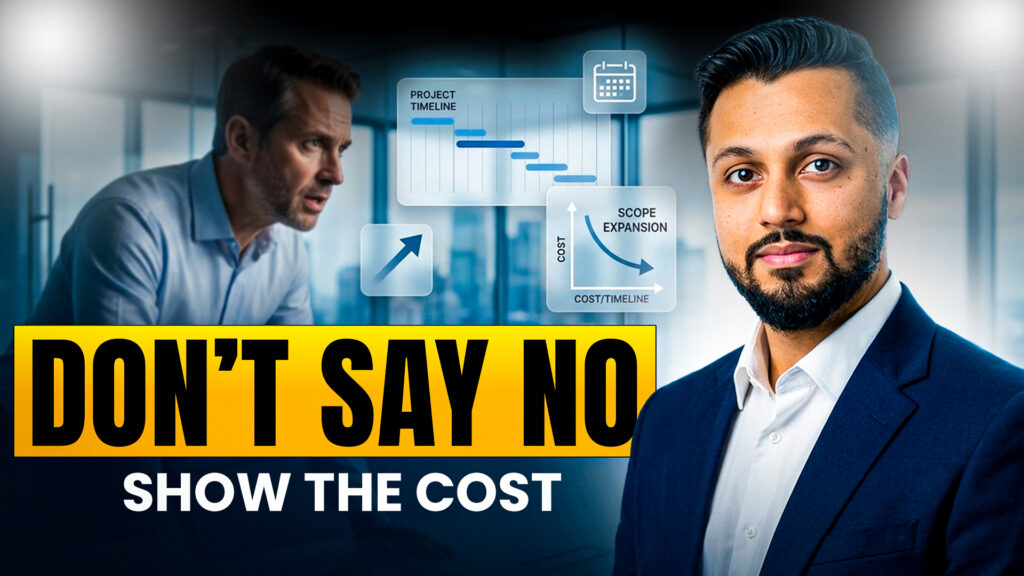
Saying no to an executive is rarely the right move. It puts you in a fight you cannot win and signals that you do not understand the business. The right move is making the cost of the yes visible, clearly, calmly, and in business terms, then letting the executive decide whether they still want the trade.
Senior PMs do not push back by saying no. They push back by surfacing the tradeoff. They translate the request from “what the executive wants” into “what the executive will be giving up,” and they put the decision back in the executive’s hands with information the executive did not have when they asked.
This works for two reasons. First, executives respect people who think through second-order effects. When you walk through what a yes means for cost, scope, timeline, or team capacity, you show them you operate at their level. Second, most executives genuinely do not know the cost of what they are asking for. They are trying to solve a business problem. When you make the tradeoff visible, you are not refusing them. You are helping them.
Here are the four techniques that put this principle into practice.
Technique 1: “Yes, and the Tradeoff Is”
When an executive asks for something, never lead with no, and never lead with a flat yes that hides the cost. Lead with: “Yes, and the tradeoff is.” Then name the tradeoff specifically.
“Yes, we can pull the deadline forward by two weeks. The tradeoff is we drop the reporting module from the launch and ship it in phase two.”
“Yes, we can add the new feature. The tradeoff is the integration testing window shrinks from two weeks to four days, which raises the risk of a defect getting into production.”
You did not say no. You did not fight. You put the executive in possession of information they did not have. If they accept the tradeoff, you are aligned. If they walk it back, you protected the project without ever refusing them.
Technique 2: “What Would You Have Me Deprioritize?”
This one is for requests that require you to do more, not differently. An executive asks you to add a brand new initiative on top of everything you are running. You cannot say yes without breaking something else, but you cannot refuse either. So you ask the question that puts the priority decision back in their hands:
“Happy to take this on. To make room for it without slipping the current commitments, what would you have me deprioritize?”
That single question signals you are willing to help, shows you understand capacity is finite, and forces the executive to look at what is already on the board. Most of the time the response is “let me think about that,” which is a polite way of saying “I did not realize what I was asking for.” The request quietly disappears, comes back smaller, or comes back with something moved off your plate. All three outcomes protect the project.
Want a structured path into project management? Here is exactly how to become a project manager, step by step →
Technique 3: “Let Me Come Back With Three Options”
Junior PMs answer in the moment, while the executive is still in the room. Senior PMs almost never do. They say: “Let me come back with three options by end of day tomorrow.”
That buys you time to think through the implications, space to talk to your team, and the chance to return with a structured response instead of a panicked one. It also changes the dynamic: you are no longer reacting to a request, you are presenting options to a decision-maker. That is the posture executives associate with senior PMs.
The format: Option A is the request as stated, with tradeoffs named. Option B is a modified version that reduces the cost. Option C is a different approach that solves the underlying business problem another way. The executive picks and feels in control. You control what is actually on the table.
Technique 4: Escalation as a Favor
This is the most advanced move, for when a request is genuinely going to hurt the project and softer techniques are not enough. The instinct is to dig in and defend the project. That instinct is usually wrong. Instead, escalate the decision, but frame the escalation as a favor:
“I want to make sure you have cover on this one. The tradeoff is significant enough that I think it is worth getting your boss aligned before we commit. Want me to set up the conversation?”
You are not refusing. You are protecting the executive from a decision that might come back to bite them, and demonstrating that you think about their political safety, not just the project. Most of the time the executive walks the request back themselves, because they wanted something fast, and getting it fast now means getting it on record. Use this one sparingly, but used well it builds enormous credibility. Executives start to see you as someone who watches their back.
The Story: A Compliance Request That Became Its Own Project
A few years ago I was running a major infrastructure migration. Six months in, the executive sponsor asked me to fold a brand new compliance initiative into the same project without changing the timeline.
The earlier version of me would have said yes and tried to figure it out. Instead I said: “I can take this on. The tradeoff is the original migration date moves out by about ten weeks, or we cut the testing window in half, which significantly raises the risk of a production incident. Which would you prefer?”
He stared at me for a second and said, “Let me think about that.” By the end of the day, the compliance initiative had been spun off as a separate project with its own timeline and budget. I did not refuse anything. I just made the cost visible, and he made the decision he was always going to make once he saw the full picture.
The Four Techniques in One Breath
- Technique 1: “Yes, and the tradeoff is.”
- Technique 2: “What would you have me deprioritize?”
- Technique 3: “Let me come back with three options.”
- Technique 4: Escalation as a favor.
None of these are about refusing executives. All of them are about making the cost of saying yes visible, so the executive can make a real decision instead of a reflexive one. That is what separates a PM who gets steamrolled from a PM who gets promoted.
If you want to actually practice these moves in a real project environment, running real status meetings, handling real escalations, and getting real feedback when you handle a stakeholder situation badly, that is what my Live PMO is built for. Join The Eddie System on Skool →