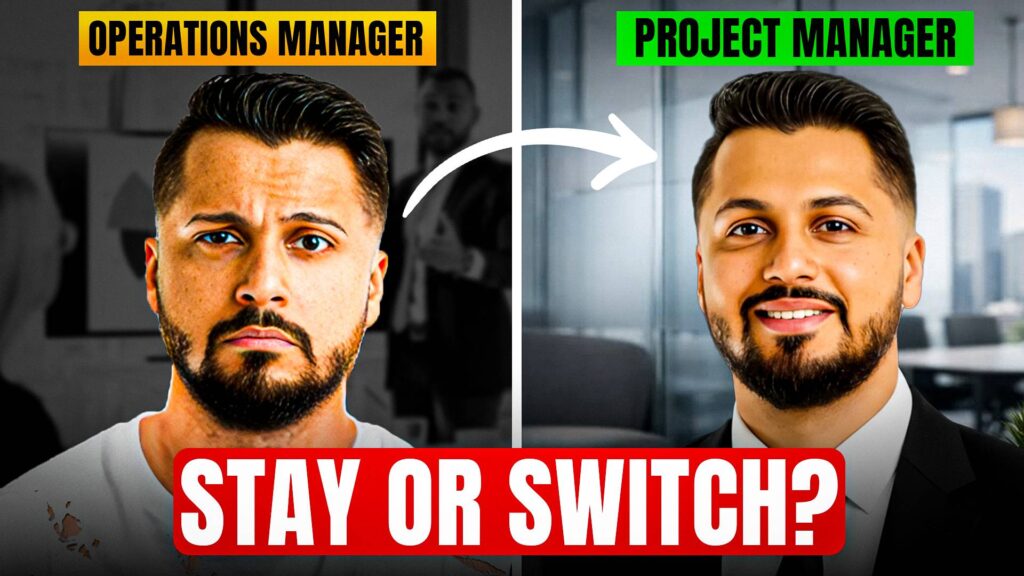
Every comparison of business analyst and project manager tells you the same thing. Here is what a BA does. Here is what a PM does. Here are the salaries.
That is exactly why so many people still cannot decide. The real question is not what the jobs are. It is which one will actually hire you from where you are standing right now. And for a lot of people, the answer is not the one they expect.
I have been an IT project manager for over 10 years, and on almost every project I have run, there has been a business analyst sitting right next to me. So I have seen both jobs up close, on the same projects, on the same bad days. I have also helped dozens of people break into project management, including people who grew from BA roles into PM roles. The question I get asked most is some version of this: should I stay a BA, or should I move into project management?
So I am going to answer it the way I would answer it for one of them. Not with job descriptions. With what actually happens when you try to get hired.
Where most people are when they ask this question
You are in a coordinator role, or an analyst role, or somewhere in operations or support. You know you want to move toward projects. And two job titles keep showing up: business analyst and project manager.
So you look it up, and you get the textbook answer. The BA figures out what the business needs. The PM delivers it. The BA writes the requirements. The PM manages the plan.
All true. And it does not really help you, because you are not trying to pass a quiz on job titles. You are trying to answer two harder questions:
- Which of these jobs would you actually want to be doing every day?
- Which one can you realistically get hired into from where you are right now?
Get the first one wrong, and you end up in a job that does not fit how you like to work. Get the second one wrong, and you spend a year or two applying for roles that were never going to open for you.
The difference that actually matters
The business analyst owns the what. What does the business actually need? What problem are we trying to solve? Will the solution actually fix it, or just look like it does?
The project manager owns the delivery. Getting it built, on a date, on a budget, through people who mostly do not report to them.
Put simply: a business analyst is accountable for being right. A project manager is accountable for getting it done. Same project, same meetings, completely different pressure.
When the BA is wrong, the team builds the wrong thing. When the PM is wrong, the right thing shows up late, or over budget, or not at all.
Before you go further, answer two questions honestly:
- Do you want to be accountable for being right, or for getting it done?
- Do you like going deep on one problem until you really understand it, or do you like juggling a lot of moving parts at once?
If you leaned toward the first half of both, BA probably fits you better. If you leaned toward the second half, PM probably suits you better. Here is what that looks like in practice.
What a normal week looks like in each job
A business analyst spends a lot of time in conversations that go deep. Workshops with the people who do the work. Interviews with managers. Watching how a process really runs, which is almost never how it is written down.
Then they turn all of that into something the team can build from: process maps, requirements and user stories. And later, they help test whether what got built actually does what the business needed.
A project manager’s week is wider and much shallower. Status meetings. A risk that came up overnight. A vendor who is behind. A stakeholder who wants to change the scope. A decision that has to be made by Friday.
The BA spends an hour understanding one problem properly. The PM spends that same hour on six problems, getting each one to the next step. A good week for a PM is when a decision that has been stuck for a month finally gets made.
Neither is easier. But one of those weeks probably sounded a lot more like you than the other.
How people actually get hired into each one
This is the part most comparisons skip.
Business analyst roles often reward deep knowledge of one area. If you know how claims processing works, or how the warehouse really runs, or how finance closes the month, that knowledge is exactly what a BA needs. Which means a lot of BAs get hired from inside the business. They were the person everyone asked about how things really work.
If you are the person everyone asks how things really work, you might already be closer to a BA job than you think.
Project management is harder to walk into. Most hiring managers want proof that you have run delivery before: a plan, a team, a deadline, a risk you managed. That is the experience gap I talk about all the time. And the usual first door is not project manager. It is project coordinator.
So for a lot of career changers, especially people with deep knowledge of one part of the business, the BA door is closer. It is not easier. It is just closer.
And if you are set on PM, that is fine. Just know that the door you are really aiming for first is coordinator, and you will need proof of delivery to get past it.
Trying to break into project management? Start here: How to become a project manager, the full step-by-step breakdown of the path.
Where each job leads five years out
The first job is not the last one, so think five years out.
A business analyst can grow into a senior or lead BA. A lot of them move toward product: product owner, then product manager. Some become architects who design how whole parts of the business work. And a lot of them move into project management.
That last path is well worn. BAs already have stakeholder trust, they know the requirements, and they have sat in every project meeting. What they have to add is ownership of delivery: trade-offs, risks, dates and decisions.
A project manager grows into a senior PM, then a program manager running several projects at once. And because projects have an end date, PM work is also well suited to contracting.
Going the other way, from PM to BA, is uncommon. It usually feels like a step down.
Also, watch the job titles. Plenty of roles called business analyst are really project coordination, and plenty called project coordinator are half analysis. Read the duties, not just the title.
The pay is in a similar range at the start. Where it ends up depends far more on the path you take after that than on which door you walked through first.
What AI is changing about both jobs
It is 2026, and you should know this before you choose. AI tools can now draft requirements, write user stories, and summarize a two-hour workshop in a minute. They can also produce a decent status report.
That does not make either job disappear. But it changes which version of each job is safe.
The business analyst who mostly writes documents is in a weaker spot. The one who runs the room, asks the uncomfortable question, and catches what the business really meant is worth more than ever.
Same for project managers. The PM who mostly updates trackers is in trouble. The one who gets people to agree, makes the call and owns the outcome is not.
AI can write the requirements and the status update. What it cannot do is run the room, get people to agree, or own the outcome. Whichever job you pick, make sure you are building those skills.
One problem, two jobs
Here is how differently these two jobs see the same moment.
Two weeks before go-live, the team finds out a requirement was wrong. The new system calculates refunds one way. The finance team has been doing it another way for years, and nobody ever wrote that down.
The business analyst’s job starts right there. Sit with finance. Find out what they actually do, and why. Work out whether the system is wrong or the old process is. Rewrite the requirement, so the team builds the right thing this time.
The project manager’s job starts at the same moment, but it points somewhere else:
- How long will the fix take?
- What slips because of it?
- Who on the team can pick it up?
- Do we move go-live, or launch without that piece?
- And what do we tell the sponsor this afternoon?
Same problem, two different questions. The business analyst asks: what is actually true? The project manager asks: what do we do about it, and by when?
On a good project, they work it out together. The BA has the corrected requirement in two days. The PM moves go-live by a week, and the sponsor hears it from them before the steering committee does.
Both questions matter, and the project needs both people. But you will probably be happier answering one of those questions every day than the other.
How to decide
Pick business analysis if you are the person who knows how your area really works, you like understanding a problem all the way down, you are comfortable with detail and documents, and you would rather be right than be in charge of the deadline. Especially if you can make that move inside your own company.
Your first move: offer to write up how your current process really works for the next project that touches your area.
Pick project management if you like owning the outcome, a lot of moving parts gives you energy, and you can live with being accountable for things you do not fully control. Just aim for project coordinator as your first door, and start building proof of delivery right now.
Your first move on that side: run a small project in your current role from beginning to end, with a plan, a date and a status update.
Using the BA door to get to PM? Do it on purpose
If you are using business analysis as a way into project management, do not just write requirements. Own a piece of the delivery. Run the user testing. Own the go-live checklist. That is the experience that gets you the PM job later.
Which door to knock on first
It comes back to the same two questions. Do you want to be accountable for being right, or for getting it done? And do you like going deep, or juggling a lot at once? Answer those honestly, and you will know which door to knock on first.
If you are leaning toward project management and you want to practice the delivery side before anyone hires you for it, that is what the Live PMO is for. You run a simulated enterprise project from initiation to closure, and you make the decisions a project manager would make on the job as the scenario develops.
Keep reading
- Project coordinator vs project manager: what nobody tells you
- How to translate coordinator work into PM experience (without lying)
- The real reason entry-level PM jobs “require experience”
- Project manager vs cybersecurity: which career should you pick?
Ready to gain real PM experience?
For most people the first project job is project coordinator, and proof that you can deliver a project is what moves you past it. Inside The Eddie System you run governed projects across many industries in a live PMO environment, from initiation to closure, making the decisions a project manager makes as each scenario develops.