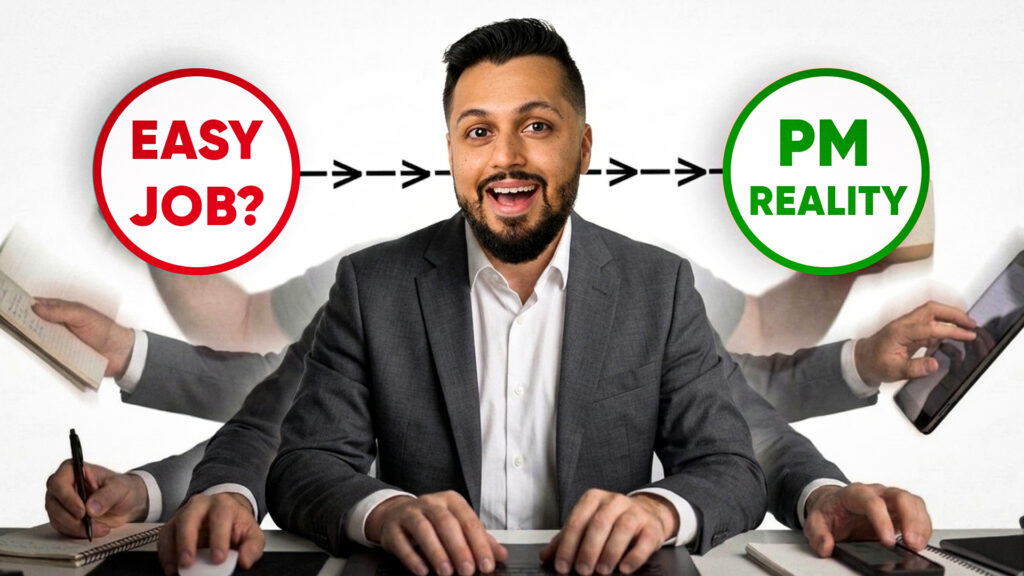
I’ve been an IT project manager for over eight years — working remotely from Mexico, Colombia, Peru, and Argentina, and in a single year I made over $300,000 doing this job. And I can tell you that the two most common things people say about PM workloads are both wrong. One side says it’s an easy job. The other says it’ll burn you out. Here’s what actually happens.
Why PM looks like “not real work”
When people look at a project manager from the outside, they often see someone who isn’t doing what they’d call real work. They’re not writing code, not building anything with their hands, not clearing a stack of tickets. They’re talking to people, sitting in meetings, sending updates. To anyone who measures productivity by visible output, that looks like a light workload. On the other extreme, people imagine the PM role as pure chaos — always on, always firefighting, never able to mentally leave the office. The truth sits in the middle.
What PMs actually produce
The work of a project manager is fundamentally different from most other roles. A developer ships code. An analyst produces a report. A coordinator completes a task. A project manager produces coordination, decisions, and forward momentum — things that are harder to see, but not lighter work. There are periods where the calendar is full and decisions need to happen fast, and periods that look slower, where the work is mostly planning, communication, and preparation. But here’s what most people miss entirely.
The work that doesn’t stop when you leave
The work of a project manager doesn’t stop when they leave the office — and I don’t mean answering emails at midnight. I mean something more subtle: PMs are almost always thinking about their projects. Driving home, they’re replaying a conversation and thinking about how to handle it differently. At the gym, they’re running through an upcoming stakeholder meeting. At dinner, a risk or dependency is quietly sitting in the background. The mental processing, the strategy work, the influence planning — it doesn’t show up on a timesheet, but it is real work. It’s one reason strong PMs show up to high-stakes situations already prepared: they’ve been working through it in the background long before the meeting.
The invisible work: influence planning
A lot of what a PM does is get things done through people they have no direct authority over. You can’t order a stakeholder to approve something, force a vendor to move faster, or demand a senior leader prioritize your project. You have to influence — and effective influence doesn’t happen spontaneously. A good PM spends real mental energy working out: Who needs to approve this? What matters to them? How do I frame this request so it aligns with their priorities? What objections will they have? What do I need to prepare before I walk into that room? That thinking happens continuously — on the commute, in the shower, between meetings. That’s not laziness. That’s how the work actually operates.
A real story: the budget approval
I was running a project for a medical device manufacturer. We needed a budget approved to place an order for equipment with a long procurement lead time — and on a project with regulatory requirements and fixed milestones, falling behind isn’t an inconvenience, it’s a real problem. I needed one director to sign off. Simple on paper. But for a few days beforehand I was thinking about it — not anxiously, more like problem-solving in the background: who this director was, what they cared about, what would motivate them to act quickly instead of delaying. Stakeholders delay when they don’t feel urgency, or when they feel like the only one taking a risk.
Then I remembered a principle from Robert Cialdini’s Influence: social proof — people look to what others are doing when they’re uncertain. So instead of asking directly, I went in and said: “I wanted to give you an update. All of the other directors have already approved their portions of the budget. You’re the last one we’re waiting on.” The director didn’t want to be the outlier holding things up. The approval came through that same day. That outcome didn’t happen because of what I said in the meeting. It happened because of the days I spent thinking about it beforehand. That thinking was work — even though it didn’t look like work to anyone watching.
Can organized PMs work less?
Honestly? Yes — sometimes, but it’s conditional. The PMs who manage their hours well, who aren’t constantly reactive, are the highly organized ones. They batch communication, plan ahead, anticipate problems before they hit the radar, and don’t let small issues grow into crises that need emergency hours. When a PM operates that way, the calendar can look light — meetings are purposeful, decisions are pre-prepared, status updates go out on schedule. That’s not a lack of work; that’s the work paying off. The flip side is the reactive PM: no planning, no batching, no anticipation, constantly chasing, hours unpredictable, projects chaotic. So the honest answer to “do project managers work less?” is: organized ones can. Disorganized ones absolutely do not.
What this means for you
If you’re working toward a PM role, three things matter. First, understand that PM work is cognitive work — the measure of a PM isn’t how many tasks they complete in a day, it’s the quality of their thinking, their decisions, and their ability to move things forward through influence and coordination. That’s a different kind of output, but it’s still output. Second, start developing the mental discipline now — get comfortable thinking through problems and conversations before they happen, focusing on what the other person needs to hear, not just what you want to say. Third, build the organizational systems that let you work ahead — the PMs respected for their efficiency aren’t working less because they’re lazy; they’re working less because they planned better than everyone else.
The bottom line
So do project managers really work less? The honest answer is that it’s the wrong question. The better one is: what does PM work actually look like? It’s not just tasks and meetings — it’s continuous thinking, planning, influencing, and decision-making. Some of that happens on the clock, and a lot of it happens in the background, whether you’re at your desk or not. Understand that going in, and you’ll approach the work very differently than someone just expecting a lighter schedule.
The best way to understand what PM work really is? Do it. Run real projects, with real stakeholders and real decisions.
Related reading:
- Project Management Salary Guide 2026: How Much Do PMs Really Make?
- What I’d Stop Doing Today If I Wanted a 6-Figure PM Career Faster
- Most Valuable (Remote) Project Management Skills in 2026
- Project Management Skills: The Complete List (20 Skills That Matter)
Ready to close the Experience Gap? Join The Eddie System on Skool →
Ready to gain real IT PM experience?
See what PM work actually is by running real projects inside a live PMO.