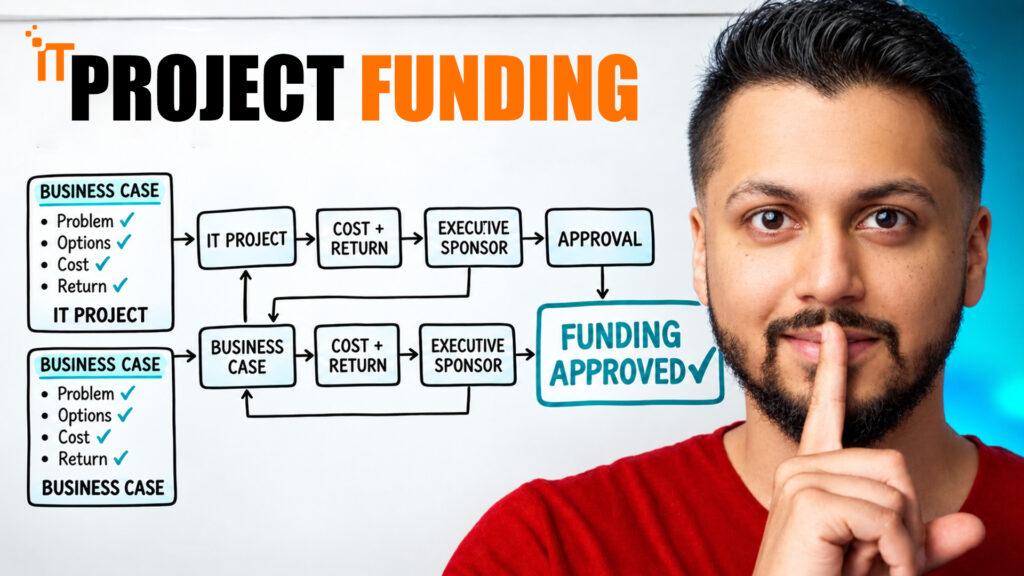
Before a single line of code gets written, before anyone is assigned, before the project even officially exists, it has to survive something almost nobody talks about. The funding process.
This is the invisible part of project management. It happens in rooms most people never sit in, and it decides which projects live and which ones quietly die before they start.
I have been an IT project manager for over 10 years, and a big part of that job that nobody warns you about is the money side. I have written business cases. I have sat in the rooms where budgets get argued over. I have had projects I believed in get approved, and I have had others get killed, and I learned exactly why each one went the way it did. So this is not finance theory. This is what actually happens when a company decides whether to spend real money on a project.
The mistake that keeps people confused their whole career
Most people assume that if a project is a good idea, it should get funded. It is obviously worth doing, so why will they not just approve it? And when it does not happen, they decide leadership is clueless, or cheap, or political.
Here is what they are missing. “Is this a good idea” is not the question being asked. Nobody is evaluating your project on its own. They are evaluating it against everything else the company could spend that same money on.
Think about it from the top. A company has a limited pool of money for new projects this year, and a very long list of things it could spend that money on. New systems, upgrades, security work, hiring, a dozen departments all with their own wish list. Every one of those things is also a good idea to the person who wants it.
Your project is not competing against nothing. It is competing against every other good idea in the building for the same limited pot of money. Good idea is the price of entry, not the thing that wins.
So the project that gets funded is almost never just the best idea. It is the one that made the strongest case that it is the best use of the money, right now, compared to the alternatives. That is a completely different game, and once you understand it, you stop being confused about why things get approved or killed.
Funding is a sale, and the business case is what you are selling
A project does not get funded because it is good. It gets funded because someone made a convincing case that it is the best use of the money right now, and then defended that case through a process designed to say no to most things.
That word, business case, is the whole game. A business case answers four questions, in order.
- What is the problem or opportunity?
- What are the options for solving it, including doing nothing?
- What will this specific option cost?
- What does the company get back for that cost?
Problem, options, cost, return. That is it. When leadership approves a project, what they are really approving is that argument. And when they kill one, it is almost always because one of those four pieces was weak. The problem was not painful enough. The cost was too high. The return was fuzzy. Or nobody could explain why this option instead of the cheaper one.
Here is where this becomes your leverage. Very often, you are the person who builds or defends that business case. The junior PM waits to be handed an approved project. The PM who gets trusted with real budget is the one who can make the case for the money in the first place.
Phase 1: building the business case
This is where a vague “we should really do something about this” becomes an actual argument for money. Let me make the four parts real with an example.
Say your company runs an old system, and the vendor just announced they are ending support for it next year. After that, no security patches, no help if it breaks. That is your starting point.
Part one, the problem. You have to make it concrete and, honestly, a little scary. Not “the system is old.” Instead: “in fourteen months this system stops getting security patches, which puts customer data at risk and could fail a compliance audit.” Now it is a real problem with a clock on it. A weak problem statement is the number one reason good projects never get funded. If leadership does not feel the pain, they will not pay to fix it.
Part two, the options. This is the part people skip, and it is a mistake. You never present one solution. You present a few, including doing nothing. Option A, do nothing, and here is the risk. Option B, upgrade to the vendor’s new version. Option C, replace it with something better. Why show options? Because it proves you thought it through, and it lets leadership feel like they are making the choice rather than rubber-stamping yours.
Part three, the cost. The real, total cost. Not just the license. The people, the time, the training, the disruption while you switch over. Lowball this and you lose all credibility the moment finance pokes at it.
Part four, the return. What does the company get back? Sometimes that is money saved. Sometimes it is risk avoided, like not failing that audit. Sometimes it is time saved across a hundred employees. But you have to name it, and where you can, put a number on it.
Every project that gets funded can finish this sentence cleanly: if we spend this, we get that. If you cannot finish that sentence, you do not have a business case. You have a wish.
Phase 2: CapEx, OpEx, and why the bucket decides
Before your business case goes anywhere, you have to understand something about how companies think about money, because it quietly decides what gets approved. There are two very different kinds of spending, and this is the part most technical people never learn.
CapEx, capital expenditure, is a big one-time investment in something the company will own and use for years. Buying servers. A major new system. It is treated like buying a truck: a large upfront cost that gets spread out on the books over the life of the thing.
OpEx, operational expenditure, is the ongoing cost of just running the business. Salaries. Subscriptions. Your monthly cloud bill. It is not buying a truck, it is paying for gas every week.
Why does a PM need to care about an accounting distinction? Because it changes what is easy to approve. Companies often have a strong preference for one over the other in a given year, for budget and tax reasons well above your pay grade. And the same project can often be structured as either one.
The same project can be a hard yes or an easy no depending on which bucket the money comes from. Sometimes you do not need a better idea. You need to move it to the budget that has room.
Cloud is the perfect example. Buying your own servers is a big CapEx purchase. Moving to the cloud turns that into a monthly OpEx subscription. For a company that does not want a huge upfront hit this year, that shift alone can be the reason a project gets approved. Same capability, different bucket, different answer.
So the practical move is this. Early on, find out who controls the budget you would be pulling from and which kind of money is easier to get right now. A smart PM shapes the proposal to fit the money that is actually available, instead of walking a great idea straight into the one budget that happens to be empty.
Trying to break into project management? Start here: How to become a project manager, the full step-by-step breakdown of the path.
Phase 3: the three gates your case has to clear
Your business case is built and the money is structured right. Now it has to get through the approval machine, and there are three gates that decide everything.
The sponsor. A sponsor is a senior leader, usually an executive, who owns the project politically and financially. They are the one who stands up in the room and says “yes, I want this, and I will put my budget and my name behind it.” Here is the hard truth. A project without a sponsor is already dead. It does not matter how good your business case is. If nobody with power is willing to champion it, it goes nowhere. The best business case in the world with no sponsor loses to a mediocre one with a powerful champion. So before you fall in love with an idea, find out who at the top would actually fight for it, bring them the case early, and get them to believe in it. Then it is not just your idea. It is theirs, and they carry it into rooms you will never be in.
The committee. In most companies of any size, projects do not get approved one at a time by one person. They go to a steering committee or a governance board, a group that looks at all the competing projects and decides how to split the limited money. This is the competition made literal. Your project sits on a list next to everyone else’s, and they rank them. The ones that win are usually the ones that line up most clearly with what the company said its priorities are this year.
The timing. Most companies allocate this money on a cycle, usually once a year during budget season. Which means there is a window. Bring a great project at the wrong time, after the money has already been divided up, and the answer is not really no. It is “not this year.” That is not a rejection, it is a timing problem. And if you do not understand the cycle, you will take a timing problem personally and give up on something that just needed to wait for the next window.
Why projects actually die
Once you see the list, you realize it is almost never about the technology. A project gets killed or shelved for a handful of predictable reasons:
- The problem was not painful enough, so nobody felt urgency to pay.
- The return was fuzzy, so finance could not justify it.
- The cost lost credibility the moment someone poked at the lowball number.
- There was no real sponsor, so nothing carried it forward.
- It showed up at the wrong point in the budget cycle.
That is basically the whole list. And every single one of those is something a PM who understands funding can see coming and get ahead of. You can sharpen the problem. You can pin down the return. You can build a cost number that survives scrutiny. You can go find the sponsor. You can time the ask. None of that requires you to be an executive. It just requires you to understand the game most people never bother to learn.
Most PMs think their job starts when the project gets approved. The ones who get trusted with real budget understand that the job starts with getting it approved.
The same idea, killed and then funded
Years ago I watched a team try to get funding for a project to replace a painful, mostly manual process. Good idea. It genuinely would have helped. The first time they took it up, it got killed instantly.
Why? Because they pitched it as “this would make our lives easier.” That was it. No hard problem, no real number on the return, and no executive who cared. To the people holding the budget, it sounded like a nice-to-have from a team that wanted a shinier tool. Easy no.
So the next cycle they ran it back completely differently. Same project. First, they reframed the problem. They actually measured it, and it turned out the manual process was eating something like twenty hours a week across the team and causing errors that were reaching customers. Now it was not “our lives are hard.” It was “we are losing twenty hours a week and shipping mistakes to clients.”
Then they put a number on the return, tied to those hours and the cost of the errors. Then they went and found a sponsor, a director whose own numbers were getting dragged down by that exact problem. Suddenly it was his project, not just theirs. And they brought it at budget season, not randomly in the middle of the year.
The same idea that got laughed out of the room got approved with a full budget. Nothing about the technology changed. What changed was the business case, the sponsor, and the timing.
Three things to practice now
1. Learn to build the four-part business case. Problem, options, cost, return. Go practice on something real at your job right now. Take a problem you see every day and write the case for fixing it. Make the problem concrete, lay out a few options including doing nothing, put a real cost on it, and name the return. Do that a few times and you will start thinking about projects the way leadership does.
2. Before you ever pitch anything, learn the money around it. Find out who controls the budget you would pull from, whether CapEx or OpEx money is easier to get this year, who the natural sponsor would be, and when budget season actually happens. Walking in with a great idea and none of that is how good ideas die.
3. Shift how you see your own role. Stop waiting to be handed approved projects. The most valuable PMs are the ones who can take a business need and walk it all the way through funding. Even just understanding this process puts you ahead of most people who have had the title for years.
It is a process, not a mystery
The funding process feels like a black box when you are on the outside of it. Decisions get made in rooms you are not in, about money you do not control, for reasons nobody explains. So most people accept it as corporate mystery and stop thinking about it.
But it is not a mystery. It is a process. Problem, options, cost, return. The right kind of money, a real sponsor, and the right timing. Once you can see those pieces, you stop being confused about why projects live or die, and you start being able to influence it.
That is genuinely rare. Most people who work in and around projects never learn this. So the moment you do, you have separated yourself. You become the person who does not just execute the work, but understands how the work gets funded in the first place. That is the person who ends up running the big projects, with the big budgets.
So do not treat the money side as somebody else’s job. It is the most valuable part of this field to understand.
Keep reading
- What actually happens in an enterprise IT project
- How senior PMs push back on executives
- What is a PMO?
- How project managers actually think
Ready to gain real IT PM experience?
You learn how projects get governed by running them. Inside The Eddie System you work through governed IT projects in a live PMO environment and make the calls yourself.