I run a near-fully-automated content operation, an online PMO with hundreds of active members, and the development of new tools and processes for myself, my students, and the companies I work for — and I do most of it solo. The only reason any of it functions without falling apart is systems. Not complicated systems or expensive software — just repeatable processes that run the same way every time.
Quick context: I’ve been an IT project manager for over eight years, working remotely from Mexico, Colombia, Peru, and Argentina, and in a single year I made over $300,000 doing this. None of that would be possible without systems — and I don’t mean that in a vague, motivational sense. I mean it literally. The reason I get so much done without reinventing the wheel every week is that I took the time to build repeatable processes around the work.
What “systems thinking” actually means
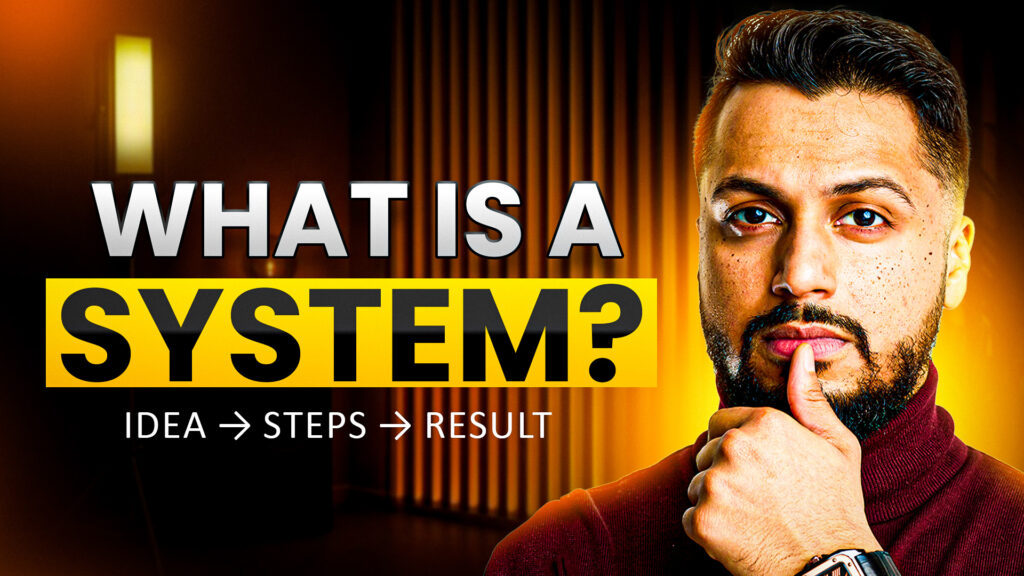
“Systems thinking” gets packaged and sold as something sophisticated — something that requires a special mindset or a special kind of intelligence. You’ll hear people talk about feedback loops, interconnected variables, and emergent behavior, and if you’re not fluent in that language it’s easy to assume this lives in the world of consultants and executives, not your day-to-day work. So most people ignore it — and miss one of the most practical ideas in life and business. Because stripped of all the jargon, systems thinking is just this: if you do something more than once, you can build a repeatable process around it. A system isn’t software or an org chart or a complex flowchart. It’s a sequence of steps that produces a consistent result, runs the same way every time, and doesn’t depend on you remembering how you did it last time.
The simplest definition of a system
A system is anything you do repeatedly that has been given a defined structure. Before a system exists, a task lives in your head — you figure it out as you go, make slightly different decisions each time, and when you hand it off, the other person has to figure it out all over again. After a system exists, the task has a home: a sequence, a standard, a clear start and end. Anyone who follows the steps gets the same result. And here’s the part most people miss: the difference between someone constantly overwhelmed and someone who operates at a level that shouldn’t be possible for one person is usually not talent or hours worked — it’s how much of their operation has been systematized. You don’t build a system by designing the perfect process from scratch; you build it by doing something once, noticing what worked, and writing it down so you never have to figure it out again.
Example 1: my YouTube content system
On the surface, making a YouTube video looks like a creative free-for-all. But at any kind of scale, treating it that way every time will break you. Every video I make follows the same defined sequence: idea research (evaluated and tracked in a Notion dashboard), then structured script development (hook first, then section by section, each reviewed before the next), then recording, then a standardized editor brief, then review, approval, and upload. There are even sub-systems inside the system — a defined process for writing captions and creating thumbnails. Every step has a defined output, and every output feeds the next step. The consistency is what makes it scalable: I’m not making new decisions every time I start a video — the structure already exists, and I just follow it.
Example 2: the Live PMO member system
My second example is the system for activating new members inside our Live PMO — where people get real, hands-on IT project management experience. It doesn’t start when someone joins; it starts before they ever hear about the program. It starts with ads built around a specific problem: smart, capable people who’ve studied project management for years but still aren’t hireable because they’ve never worked inside a real project environment. The ad doesn’t sell — it just makes the right person aware the problem has a name. From there they’re invited to a structured Live PMO walkthrough (same format every time), and if they join, they move through a five-step onboarding sequence that never changes. The result is that every member has the same starting point, so they get up to speed at the same pace regardless of when they joined. Awareness → walkthrough → decision → onboarding: four defined stages, each feeding the next. That’s what a system looks like applied to growth and people operations.
A story: my content before systems
When I first started producing content consistently, I had no system. Every video was its own project I figured out from scratch — where to save files, what to call them, how to structure the script, when to send it to the editor, what feedback to give. It worked fine at one video here and there. But at one a week, the cracks showed: I’d lose track of which script was final, files ended up in the wrong place, the editor got different instructions each time and returned inconsistent results. Small things that compounded and ate my time. So one day I sat down and mapped out what I was actually doing when a video came together well — and realized there was already a rough pattern; I was just executing it inconsistently. I wrote it down, formalized the steps, created a folder structure every video would use, standardized naming, and defined each handoff. It took maybe two hours. From that point on the process just ran — and that two hours of work compounded for every single video that came after it. That’s what building a system actually looks like. It’s not a big redesign — it’s taking something you already do and giving it a defined structure.
3 practical takeaways
- Look for repetition. Any task you do more than once is a candidate. Start with whatever you do most often or whatever causes the most friction when it’s unstructured — that’s where a defined process pays off fastest.
- Write it down before you optimize it. The first version doesn’t need to be perfect; it needs to exist. Map what you already do, give it a sequence, document it. You can’t refine something that only lives in your head.
- Build sub-systems inside your main systems. Once the top-level process works, give each step its own structure — naming conventions, folder structures, templates, review criteria. The more you have, the less cognitive load you carry, because the decisions are already made.
The bottom line
Systems thinking isn’t reserved for consultants or operations leaders or people running large teams. It’s just the practice of making things repeatable. Every time you take something you do regularly and give it a defined structure, you’re thinking in systems. The examples here — content production and member activation — do completely different things, but they’re built on the same idea: a defined sequence, consistent standards, predictable outputs. And the compounding effect is significant: every hour you invest in a system pays back every single time it runs. It’s one of the few things in business where work you do once keeps returning value indefinitely. So start with one thing you do regularly that currently lives in your head — write down the steps, define the standard, and run it the same way twice.
Want to see real PM systems in action? Get inside a live PMO and run real projects with real structure.
Related reading:
- Project Management Skills: The Complete List (20 Skills That Matter)
- Most Valuable (Remote) Project Management Skills in 2026
- What I’d Stop Doing Today If I Wanted a 6-Figure PM Career Faster
- Top Project Management Skills to Learn Before 2030
Ready to close the Experience Gap? Join The Eddie System on Skool →
Ready to gain real IT PM experience?
See real PM systems in action — run live projects inside a working PMO.