If you work in operations, you have seen this happen.
A project team shows up and changes your system, your process, maybe your whole floor. A few months later, they move on to the next project. And you are the one who lives with what they built.
On paper, your job and theirs look almost the same. In practice, they are opposites. And which side you are on decides a lot more than your salary.
I have been an IT project manager for over 10 years, and I have helped dozens of people break into project management. A lot of them started in operations roles. Almost every project I have run ended the same way: we built something new, a system or a process, and then we handed it over to an operations team that had to run it every day after we left. So I have spent my whole career working right next to operations people. I have sat across from them in planning meetings, I have watched them push back when we got something wrong, and I have watched how their careers played out compared to the people on the project side.
I am not an operations manager, and I will not pretend to be one. But I have spent over 10 years on the project side of that handover, and I can show you where these two careers split.
The fork most operations people drift through
Maybe you are a coordinator, a supervisor or a team lead, in logistics, a warehouse, a store, a hospital, a call center or a back office. You are good at it, and people rely on you.
Sooner or later, one of two things happens. Someone offers you the next step up in operations. Or a project comes through your area, you watch the project manager running it, and you think: I could be running this myself.
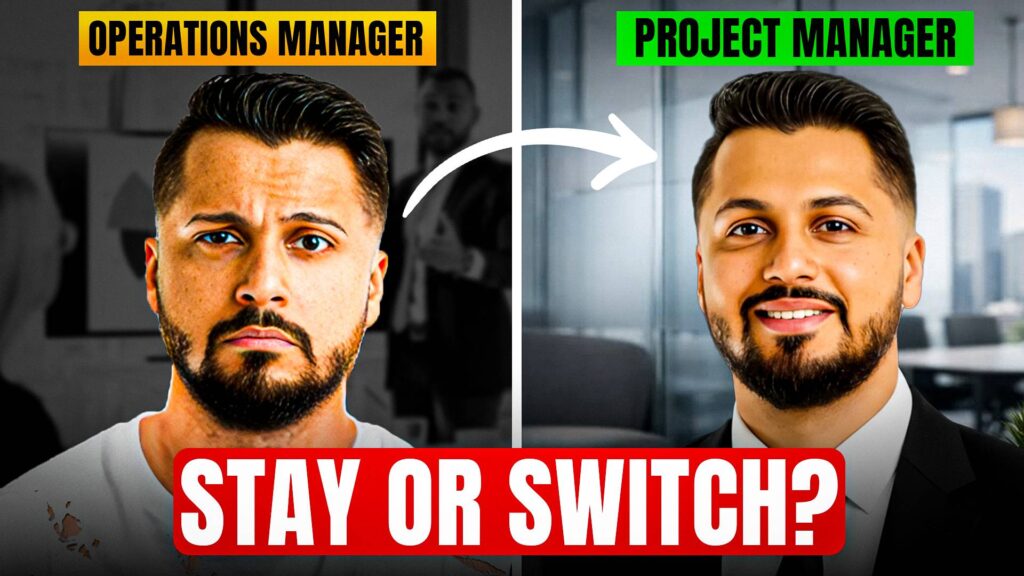
Either way, you are standing at a fork. And most people do not really choose a direction. They drift. They take the operations promotion because it is the next step in front of them. Or they look up what project managers earn, see it is about the same, and decide the switch is not worth the risk.
Staying in operations is not the mistake. Staying by default is.
The advice out there does not help much. Search “operations versus project management” and you get a textbook answer: projects are temporary, operations are ongoing. That is true, but it does not help you decide anything. On paper, the two jobs look almost identical. Both coordinate people. Both manage budgets and schedules. The median pay is nearly the same. So it looks like a coin flip. It is not.
Drift into the operations promotion, and five years from now you can be deeper into one company’s way of doing things than ever, with experience that is hard to sell to the next employer. Switch for the wrong reasons, and you can trade a team you actually manage for a job where you are responsible for things you do not control.
So I am not going to compare job descriptions. I am going to compare what each of these jobs does to your career over the next 10 to 15 years.
The one fact behind every difference
Operations and project management are not two versions of the same job. They are opposites.
Operations exists to keep things running the same way every day. The orders go out. The shifts get covered. The patients get seen. When operations is working, today looks just like yesterday.
Projects exist to change things: a new system, a new process, a new way of working. And then the project ends, and the team moves on to the next one.
Operations keeps things the same. Projects change things, and then they end. Almost every difference between these two careers comes from that one fact. It decides who reports to you, whether anyone notices your best work, whether your experience follows you, where you can work, how you get paid, and what wears you down.
Before we go through those, answer two questions honestly:
- When something is running smoothly, do you feel satisfied, or do you get restless? People who do well in operations take real pride in a system that runs well. People who do well on projects get restless once the thing is built.
- Do you want your value tied to one operation, or to a skill you carry from company to company?
Hold on to your answers. Everything that follows comes back to them.
Difference 1: A normal Tuesday
In operations, the day starts before you sit down. Someone called out sick, so the schedule needs fixing. Yesterday’s numbers came in, and one of them missed target. A delivery is late, a system is down, or a customer escalated something overnight. You spend the morning on all of that, then you walk the floor and check in with your leads.
Tomorrow, you do it all again. The problems change shape, but they are the same kinds of problems. The work resets every morning.
A project manager’s Tuesday looks different. You run a status meeting at 9. At 10, a stakeholder wants to change something everyone agreed to last month, and you spend an hour working out what that change would cost. You chase a vendor who is behind on their promises, update the risk log, and get ready for Thursday’s steering committee.
And the problems change every few weeks, because the project is moving. First it is planning, then building, then testing, then go-live, handover and support. Then the project is over, and you start something new.
Notice which of those two Tuesdays sounded more like you.
Difference 2: Authority
This is the difference that surprises people most when they cross over.
In operations, you usually manage a team. They report to you. You set their schedules, approve their time off, help hire them, and deal with it when someone is not performing. When you need something done, you can assign it to one of your leads.
On a project, most of the people doing the work do not report to you. The developer reports to an IT manager. The analyst reports to finance. The person from operations reports to their own boss. They have been lent to your project, and they still have their day jobs. So you cannot just assign them work the way you could as an operations manager. You get it done through clear plans, clear deadlines, and good relationships with the managers who own those people’s time.
In operations, you have authority over your people. On a project, you are responsible for the outcome, and you have authority over almost nobody.
Some people find that freeing. No more attendance conversations, no more quarterly reviews, no more covering shifts. Other people find it maddening. If you want to know how project managers get work done without that authority, I wrote a full breakdown: how to run a project when you have no authority.
Difference 3: Who notices your work
In operations, your best day is the day nothing happens. Nothing breaks, nothing is late, and nobody complains. And nobody remembers a day when nothing happened.
Operations mostly gets noticed when something goes wrong. Run a great operation for three years, and from the outside it can look like nothing much is going on.
Projects are built differently. There is a start date, a go-live, and an email to leadership announcing that the new system is live. And there is a name attached to it.
That cuts both ways. When a project fails, everyone knows whose project it was. But here is why it matters for your career. When you go for your next job, you have to point at something and say, “I did that.” A project hands you that by design. In operations, you have to work much harder to turn three good years into something you can point at.
That is one reason good operations people get passed over. The work is excellent. It is just hard for anyone to see.
Trying to break into project management? Start here: How to become a project manager, the full step-by-step breakdown of the path.
Difference 4: Whether your experience travels
The fourth difference is what happens when you want to leave, or move.
A lot of operations knowledge is local. You know this building, these systems, these people, and every workaround that keeps the place running. That is valuable, but most of it stays behind when you leave. What does travel tends to stay inside your industry. A warehouse operations manager can move to another warehouse. Moving into banking operations is much harder.
Project management travels further. Planning the work, managing risks, reporting status and getting decisions made work much the same way in healthcare, banking, retail and tech.
Operations experience travels within an industry. Project experience travels across industries.
Then there is where you can physically be. Many operations jobs are tied to a place, because the operation is a place: a warehouse, a store, a hospital, a manufacturing plant. A lot of project work is not. I have run projects remotely from Mexico, Colombia, Peru and Argentina. You cannot run a warehouse from another country. You can run a project from one.
Difference 5: Money, and how you climb
Money is where most comparisons start and stop. At the median, the pay is close. US government salary data puts both operations managers and project managers at right around $100,000 a year. If you stop there, there is no reason to move.
The real difference is in how you climb.
In operations, you climb a ladder inside the company: supervisor, manager, senior manager, director, VP of operations. Every rung has fewer seats, and most of them only open when someone leaves. You can be ready for years and still be waiting for the next opportunity.
Project management has a ladder too: project manager, senior project manager, program manager, maybe portfolio manager. But it also has something operations mostly does not, and that is contracting. A project has an end date, so companies bring in contract project managers all the time to run one project and move on to the next. Operations runs every day, so companies mostly staff it with permanent employees.
Contracting is not for everyone, and there can be gaps between contracts. But on the project side, the option is there.
The ceiling is different too. I made over $300,000 in a single year as a project manager, working remotely and managing multiple projects at the same time. In operations, you would usually need a senior executive title to make that kind of money.
Difference 6: What burns you out
Both of these jobs can burn you out. They just do it differently.
Operations never ends. It runs on weekends, on holidays, and while you are on vacation. When someone does not show up, you cover their shift. When the system goes down at two in the morning, you are the one who gets the call. There is no finish line, because the whole point is that it keeps going.
Projects have finish lines, and that is a real relief. But the pressure is different. You are accountable for a deadline you probably did not set, delivered by people who do not report to you, on a budget someone else approved. When it slips, your name is on it, even when the cause was somewhere else.
One industry report this year found about half of project managers dealing with burnout. So this is not the easy way out.
Operations wears you down because it never stops. Projects wear you down because you are responsible for things you do not control. Pick the pressure you can carry.
Where the fork shows up in real life
In real life, this fork almost never shows up as one big decision.
Picture a company rolling out a new system into an operation: a new warehouse system, a new scheduling tool, or a new ordering platform. The project team always needs someone from operations who knows how the work really gets done. Someone who can tell them that a screen will not work on the floor, or that nobody actually follows a process the way it is written. On a lot of rollouts, that person is called the super user, or the subject matter expert.
For a few months, that person lives in both worlds. They sit in the project meetings. They test the system. They train their team. They catch problems before go-live that nobody on the project side would have seen.
Then the system goes live, the project team moves on, and the super user goes back to running the floor.
I have watched people in that seat go both ways. Some go back to operations happy, with a better system and more credibility than before. Others realize they liked the project side more: the planning, the deadlines, the finish line.
The ones who crossed over almost never made one big leap. They raised their hand for the next rollout, and the one after that, until project work was their job.
Stay in operations or cross over?
Stay in operations if this sounds like you:
- You take real pride in a system that runs well.
- You want to manage your own team.
- Your company actually promotes operations leaders, and you can see the path to the next seat.
- You would rather go deep in one industry than wide across many.
That is a good career. Just choose it on purpose.
Cross over to projects if this sounds more like you:
- You get restless once something works.
- You want your experience to travel across companies and industries.
- You want the option to work remotely or to contract.
- You can live with leading people who do not report to you.
The first move is the same either way
Whichever way you lean, start here: put your name on a project.
Raise your hand for the next system rollout or process change that hits your team. Run your part of it like a project, and write down the goal, the plan, the risks, the decisions and the result.
If you stay in operations, that is the most visible thing you will do all year. If you cross over, it is your first real piece of project experience.
The two questions that decide it
When something is running smoothly, do you feel satisfied, or restless? And do you want your value tied to one operation, or to a skill you carry with you? Answer those honestly, and the choice gets a lot clearer.
If you are leaning toward projects and you want to try the project side before you bet your career on it, that is what my Live PMO is for. You run a simulated enterprise project from initiation to closure, making the calls a project manager makes as the scenario develops, day by day. In Live PMO mode, you build the actual documents at each of the four phase gates and present them live. One of the simulations is a warehouse management system rollout, so you see the handover to operations from the project side.
Keep reading
- Project coordinator vs project manager: what nobody tells you
- Project manager vs cybersecurity: which career should you pick?
- How to translate coordinator work into PM experience (without lying)
- What project managers actually do all day
Ready to gain real PM experience?
If you are leaning toward projects, try the project side before you bet your career on it. Inside The Eddie System you work through governed projects across many industries in a live PMO environment, from initiation to closure, making the calls a project manager makes as the scenario develops. One of them is a warehouse management system rollout, so you see the handover to operations from the project side.