If you’re a project coordinator and you find yourself thinking “I’m basically doing the same job as the project manager, so why am I still here?” — this article is for you.
Yes, on the surface you’re doing a lot of the same things PMs do. Same meetings, same trackers, same stakeholders. But what no one tells you is that the difference between a project coordinator and a project manager isn’t experience or how hard you work. It’s something structural.
Why Companies Blur the Roles on Purpose
Most people stuck in coordinator roles assume they’re missing something — more skills, more confidence, maybe a certification. But in reality, you feel stuck because companies blur the roles on purpose. Companies are designed to get work done, not to help you grow your career. If you’re dependable, organized, and good at keeping things moving, the system rewards you by giving you more of the same work — not more ownership.
The Real Difference: Activity vs Accountability
Just because you’re doing the same tasks does not mean you have the same level of responsibility. Most people measure this gap using the wrong measuring stick — they’re looking at activity instead of accountability.
The gap between a project coordinator and a project manager is not about doing more work. It’s about owning the outcome of that work.
The Plane Analogy
Think about flying a plane. Dozens of people are involved in getting that plane safely to its destination. But only one person is responsible for what happens if something goes wrong at 30,000 feet. That person didn’t get the role by doing more tasks. They got it by accepting a different kind of responsibility.
That’s the same structural difference between a coordinator and a PM. You can both be in the same meeting, tracking the same deliverables, talking to the same stakeholders. But when something breaks, the PM is the one who decides what happens next — and is accountable for the consequences.
How Ownership Plays Out in Real Projects
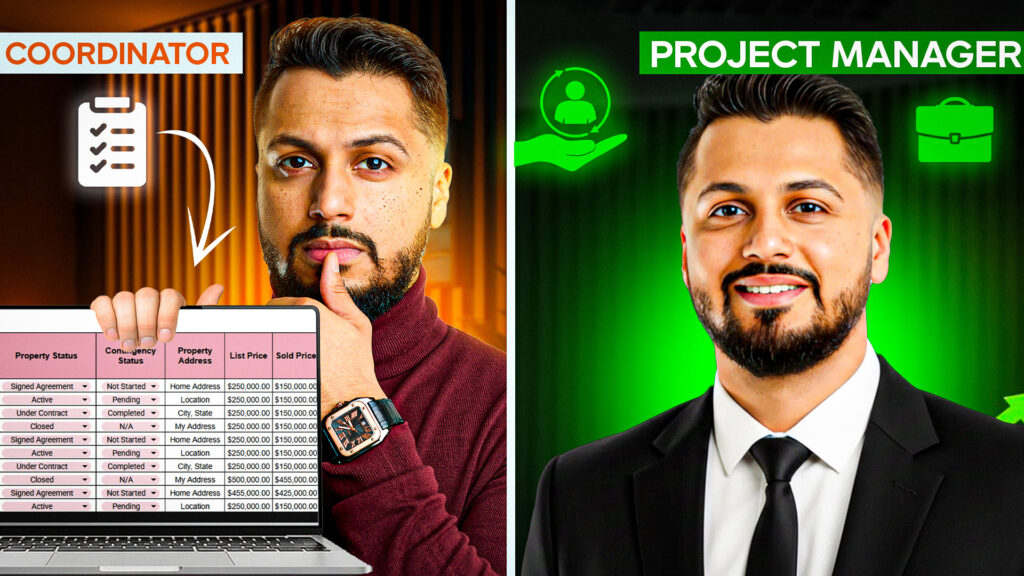
When a stakeholder is unhappy, the coordinator documents concerns, schedules a follow-up, maybe drafts talking points. The PM decides whose priority wins. They decide whether to escalate, absorb the risk, or reset expectations — and their judgment gets evaluated afterward.
When a deadline slips, the coordinator updates the timeline and flags the delay. The PM decides what to cut, what to push, and who needs to hear about it — then owns whatever happens as a result.
Same situations, same tasks visible from the outside. Completely different weight.
The Weight of PM Decisions
Coordinators live in a world where decisions are mostly reversible. If you schedule the wrong meeting or miss a follow-up, it can be corrected. PMs live in a world where some decisions permanently shape outcomes — budget allocations, scope trade-offs, stakeholder commitments.
That difference changes how work feels. The PM is evaluating trade-offs, anticipating second-order effects, deciding when to step in and when to let things play out.
Why You Haven’t Been Promoted Yet
Here’s the honest truth: if you’re not willing to own the budget and the consequences, you’re not ready to be a project manager yet. And that’s okay.
But thinking “if I just keep doing good work, someone will finally notice” doesn’t work for PM. It isn’t a reward for being patient. Sometimes you’ll see someone less technical, less organized, less experienced step into a PM role before you — because they showed they could make decisions without being asked, absorb uncertainty, and stand behind outcomes.
The Mindset Shift That Changes Everything
Stop asking “when will they let me be a project manager?” and start asking “where can I start taking ownership without officially having the title?”
The moment you move from supporting outcomes to owning them — even in small, contained ways — your role begins to change. When you understand that, you stop waiting to be chosen and start positioning yourself as someone who already thinks like a project manager.
Want to shortcut the learning curve? Inside The Eddie System’s Live PMO, you gain real IT project management experience — not theory, not case studies — actual hands-on practice managing projects in a live environment.
Key Takeaways
- The difference between coordinator and PM isn’t tasks — it’s accountability for outcomes
- Companies blur the roles on purpose because it gets work done cheaply
- PM responsibility shows up when things go wrong, not when things are smooth
- You won’t be promoted by doing more coordinator work — you need to demonstrate ownership
- Start taking responsibility before you have the title
Related Articles
- How to Transition Into Project Management (Step-by-Step)
- The Hidden Career Path Into PM Nobody Talks About
- How We Solved the ‘No Experience’ Problem
- How Project Managers Are Actually Made
Ready to Close the Experience Gap?
Join The Eddie System — gain real IT PM experience inside a live PMO environment.